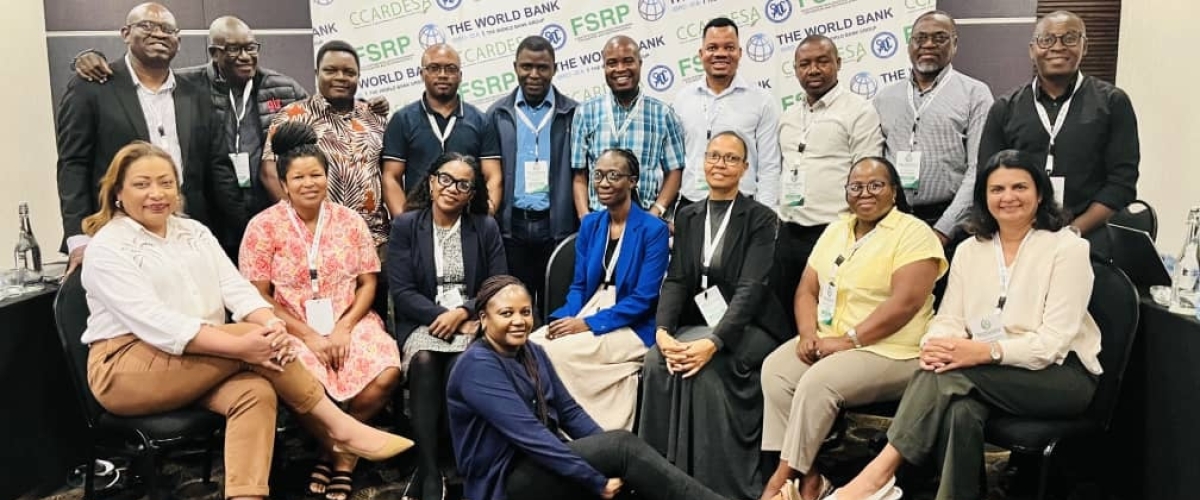
The Centre for Coordination of Agricultural Research and Development for Southern Africa (CCARDESA) recently facilitated a regional training workshop on Experimental Designs, Data Management and Advanced Statistical Analysis, held from 8–12 December 2025 in Johannesburg, South Africa, as part of its continued efforts to strengthen the capacity of National Agricultural Research Systems (NARS) across the SADC region.
Implemented through the Food Systems Resilience Programme (FSRP), the training responded to the growing demand for robust, data-driven agricultural research at a time when food systems are under increasing pressure from climate variability, resource constraints and evolving development priorities. Strengthening the ability of agricultural scientists to generate credible, high-quality evidence remains critical for informing policy, guiding investment and supporting sustainable productivity gains.
The training addressed persistent capacity gaps in the application of advanced statistical techniques and modern data management approaches that often limit the practical impact of agricultural research. Through an intensive and practically oriented programme, participants enhanced their ability to design sound agricultural experiments, manage and analyse complex datasets, and interpret results in ways that support climate adaptation, food security and agricultural innovation.
A defining feature of the workshop was its highly interactive and hands-on approach. The programme blended conceptual discussions with computer-based practical sessions, enabling participants to work directly with real datasets and analytical tools. Core areas covered include experimental design principles, data quality assurance, multi-environment trial analysis, stability analysis, advanced data exploitation methods, and the interpretation of statistical outputs relevant to agricultural research.
Participants were also trained in the practical use of a range of contemporary analytical platforms and software packages, strengthening their capacity to manage and analyse complex, multi-location and multi-season datasets. Beyond analysis, the programme placed strong emphasis on data visualisation and scientific reporting, equipping participants with skills to produce publication-quality graphics and to structure research outputs for submission to peer-reviewed journals, an area identified as critical for improving the visibility and uptake of regional research findings.
Throughout the training, discussions were dynamic and reflective of real challenges faced by agricultural scientists in the field. Key areas of engagement included experimental replication and randomisation, treatment design, data formatting across software platforms, interpretation of statistical significance, handling outliers, and making sound conclusions from complex analytical outputs. These exchanges reinforced peer learning and helped ground theoretical concepts in practical research contexts.
By the end of the workshop, participants reported increased confidence in applying advanced statistical and data management techniques and expressed readiness to share newly acquired skills with colleagues in their home institutions. The training also helped lay the foundation for sustained collaboration among scientists across the region, encouraging continued knowledge exchange and collective problem-solving in agricultural research.
The initiative is aligned with CCARDESA’s mandate to enhance research excellence and regional knowledge sharing, while directly supporting the FSRP’s objective of building resilient, inclusive and sustainable food systems in Southern Africa. Through targeted investment in advanced analytical skills, the training strengthened the region’s capacity to ensure that agricultural research delivers credible, policy-relevant and actionable solutions for farmers, policymakers and other stakeholders.