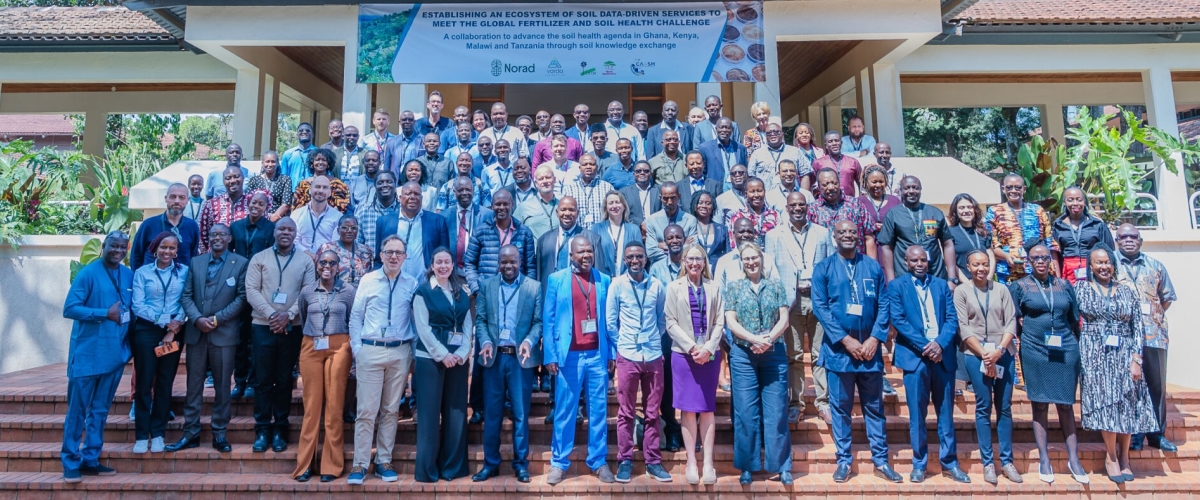
CIFOR ICRAF convened the inception workshop for Establishing an Ecosystem of Soil Data Driven Services to Meet the Global Fertilizer and Soil Health Challenge on 27–28 January 2026 at its Nairobi campus in Kenya. The workshop brought together global and regional experts to advance data driven solutions for sustainable land management, improved soil health, and food security across Africa.
The two day meeting marked the official launch of a three year initiative funded by the Norwegian Agency for Development Cooperation (Norad) and implemented by CIFOR ICRAF in collaboration with the Varda Foundation and other partners. The project seeks to scale soil information services in Ghana, Kenya, Malawi, and Tanzania, enabling evidence based fertilizer use, land restoration, and informed agricultural decision making.
Participants assessed the current state of soil health knowledge, data availability, and governance across the four focus countries. Discussions highlighted persistent challenges related to soil data accessibility, fragmentation, and interoperability, underscoring the need for systems that translate scientific data into actionable insights for policymakers, researchers, agribusinesses, and farmers.
The workshop also featured guided visits to CIFOR ICRAF’s soil laboratories, where participants gained practical exposure to soil sampling, analysis, and data generation processes. These sessions helped bridge science and policy by demonstrating how high quality soil data underpin effective advisory services and sound decision making.
A key outcome of the meeting was the co design of SoilHive, an open source digital platform that will anchor the project’s soil data ecosystem. Built on a federated architecture, SoilHive will enable countries to manage soil data locally while ensuring regional and global discoverability. The platform will support applications such as fertilizer recommendations, soil health monitoring, land restoration planning, and climate smart agriculture.
The initiative aligns with key continental frameworks, including the Comprehensive Africa Agriculture Development Programme (CAADP) Kampala Action Plan and the African Union Fertilizer and Soil Health Action Plan, which reinforce Africa wide commitments to restoring soil health and building resilient agrifood systems.
The Centre for Coordination of Agricultural Research and Development for Southern Africa (CCARDESA) participated in the inception workshop as part of the broader multistakeholder dialogue, contributing regional perspectives on soil health data coordination and governance. CCARDESA hosts the SADC Soil Health and Fertilizer Hub, which promotes harmonized knowledge exchange and policy alignment across Southern Africa. On the sidelines of the workshop, CCARDESA engaged with representatives from Norad, AUC NEPAD, the Forum for Agricultural Research in Africa (FARA), the Intergovernmental Authority on Development (IGAD), and the Coalition of Action for Soil Health (CA4SH) to strengthen collaboration in implementing the SADC Regional Fertilizer and Soil Health Programme.
By the close of the workshop, partners agreed on priority soil health use cases, capacity development needs, and a roadmap for the first year of implementation. These outcomes lay the foundation for a scalable ecosystem of soil data driven services that connect knowledge with action to improve land management, livelihoods, and food security across the region. Malawi and Tanzania, both SADC Member States, are participating in the project, with CCARDESA providing regional coordination, learning, and support for the domestication of the African Fertilizer and Soil Health Action Plan across the SADC’s 16 Member States.
Photo by: CIFOR-ICRAF